

🧿 The Blue Eye, Atlantis &
A Once-in-a-Lifetime Yoga:
Why You Need a Nazar
During This Celestial Moment
Book Your Reading

Uma’s Upayas Astrological Aromatherapy on Amazon & FREE on Kindle
FREE SIDEREAL CHART CALCULATOR
Something extraordinary is happening above us right now, and most of the world is missing it.
While Western horoscopes chatter vaguely about Cancer season, the sidereal sky—the sky we work with at Hindustan Astrology—is telling an entirely different and far more magnificent story. On this very date, June 24, 2026, there is a rare and powerful planetary combination forming in the sign of Cancer.
Exalted Jupiter is conjunct Mercury and Venus. All three radiant planets are packed together in the Moon’s watery domain. This is not just a pretty alignment. This is Saraswati Yoga—one of the most auspicious and spiritually charged yogas in all of Vedic astrology.
Named after Goddess Saraswati herself, the deity of wisdom, speech, art, and divine knowledge, this yoga blesses the world with heightened intelligence, creative brilliance, and eloquent expression. It’s a moment for poets, visionaries, and seekers. And yet, there is a shadow in the water.
Saturn is gazing.
From his current position in sidereal Pisces, Shani Dev is casting his unblinking, obstructive drishti directly toward this luminous Cancer gathering. Think of it: a cluster of pure creative light, and just out of frame, the cosmic taskmaster is watching. That tension—between exalted grace and karmic pressure—is the spiritual weather of this week.
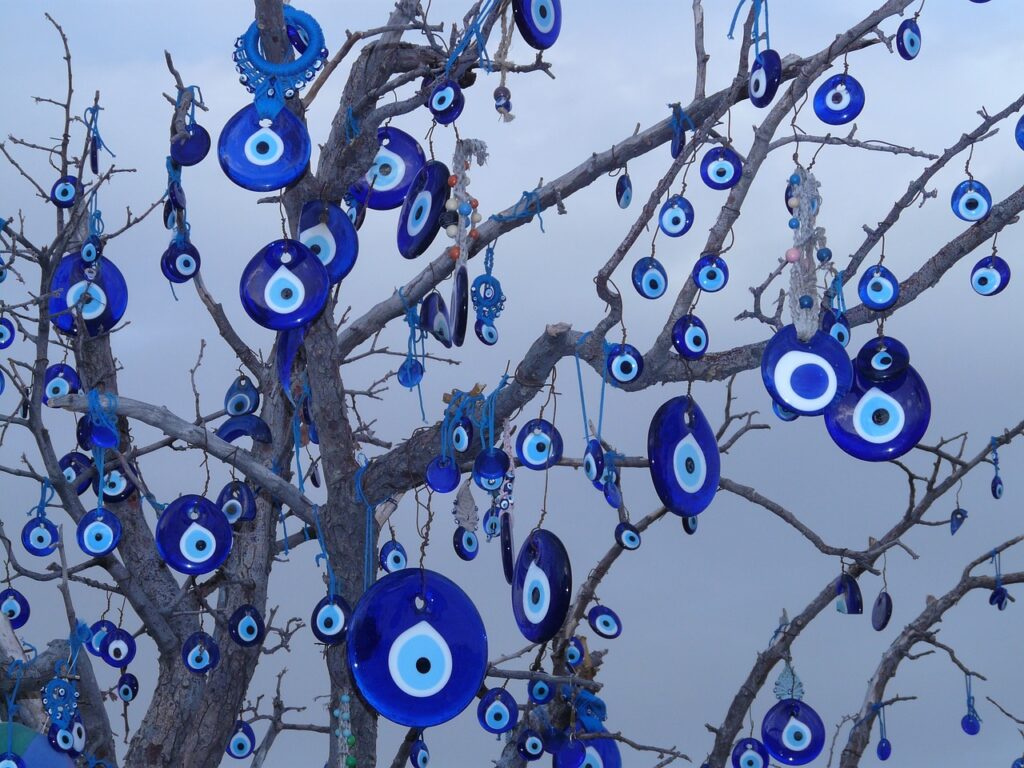
Which brings me to a symbol that’s been quietly resurfacing everywhere: the Nazar Boncugu, the mesmerizing blue-and-white eye bead. You’ve seen it dangling from rearview mirrors in Istanbul, pinned to the clothing of newborns in Delhi, and now appearing in the collections of global fashion houses. But I’m here to tell you, as a Vedic astrologer, this is no trend.
The Nazar is a spiritual technology. And in a moment like this, when Saraswati Yoga is blooming under Saturn’s gaze, it may be the most important thing you wear.
🪬 The Vedic Logic: Shani Dev’s Destructive Gaze
In Vedic thought, planets are conscious. They see. And while all grahas cast a gaze, Saturn’s drishti is the most feared in the cosmos.
The lore says Shani was so immersed in meditation upon Lord Shiva that he neglected his wife. Cursed by her fury, he was condemned: “Whatever you look at shall be destroyed.” From that moment, Saturn’s sight became synonymous with obstruction, poverty, depression, and slow, grinding delay.
If you are running a Saturn transit, a Sade Sati, or simply feel life squeezing you in slow motion, you are living under the weight of that gaze.
This is the Nazar’s purpose. The deep blue center absorbs negative energy. The concentric rings of white and light blue reflect. The amulet acts as a cosmic mirror. Saturn’s destructive gaze falls upon it, sees his own energy staring back, and neutralizes. You are not fighting Shani. You are not rejecting his lessons. You are wearing a shield made of his own reflection.
During this Saraswati Yoga, we need that shield more than ever. Jupiter, Mercury, and Venus are offering pure nectar—creative breakthroughs, healing words, artistic fire. Saturn’s gaze wants to delay, doubt, and dissolve that nectar before it reaches your lips. The Nazar says no. You may look, but you may not enter.
🌀 The Historical Spiral: From Mesopotamia to the Mediterranean
The eye symbol long predates the culture that made it famous. It was born in the cradle of civilization.
-
Mesopotamia, 3300 BCE: At Tell Brak in modern Syria, archaeologists unearthed the earliest “eye idols”—flat alabaster figures with vast, staring eyes, placed in temples as eternal watchers. Here we find the god Ninurta, a deity of law, agriculture, and the saturnine sickle—an ancient face of Saturn watching humanity long before Rome.
-
Pythagoras and the Evil Eye: The Greek sage believed envy—the most Saturnine emotion, rooted in scarcity—could travel through invisible beams from a person’s pupils. The blue eye charm, apotropaic by nature, was the only thing that could shatter that transmission.
-
Ottoman Glassmaking: When the Ottoman Empire embraced Mediterranean glass techniques, the Nazar Boncugu was perfected. Artisans blended copper and cobalt to produce that iconic blue—the precise color of the evening sky at the moment Saturn first appears on the horizon.
👁️ The Atlantis Cartography: Is the Nazar the Eye of Africa?
And now, the part that sends a shiver down the spine. Look closely at a traditional Nazar. Dark center. Light blue iris. White ring. Darker outer blue ring. It’s pure geometry.
Now look at an aerial image of the Richat Structure in Mauritania, known as the “Eye of Africa.”
When Plato described Atlantis in Critias, he didn’t describe a pyramid. He described a capital city built of concentric rings of land and water, connected by bridges. For centuries, explorers searched for a sunken island in the Atlantic Ocean. But they missed what was hiding in plain sight.
The Richat Structure is a 25-mile-wide geological dome eroded into perfectly nested rings. The “Richat is Atlantis” theory, championed most visibly by researcher Jimmy Corsetti of Bright Insight, points to three stunning correlations:
-
The Shape: It mirrors Plato’s architectural description with uncanny accuracy.
-
The Location: Atlantis was said to lie “beyond the Pillars of Hercules” (the Strait of Gibraltar). The Richat sits in Northwest Africa, just below that very line.
-
The Nazar Encoding: If survivors of Atlantis fled into the Mediterranean basin, they carried the image of their capital with them. And their capital was an eye. The Nazar bead may be no mere charm. It may be a 12,000-year-old map, a memory pressed into glass—a symbol of protection that invokes the wisdom of an advanced, lost, water-encircled civilization.
If this theory holds, then the blue eye doesn’t only deflect your neighbor’s envy. It protects against civilizational forgetting. It carries the memory of a drowned world.
🧿🪐 How to Use the Nazar During This Celestial Moment
During this rare Saraswati Yoga under Saturn’s gaze, activate your Nazar with intention.
-
Saturday is Shani’s Day: Purchase and cleanse your Nazar on a Saturday. Saturn owns this day. Wash it with salt water—salt is Saturn’s earth element, grounding and purifying.
-
Face West: Saturn’s direction is the West. Place a large Nazar on a West-facing wall or window to meet the setting sun, where the veil between worlds is thinnest.
-
The Cracking Rule: In Vedic tradition, if your Nazar suddenly cracks or shatters, rejoice. It has taken a direct hit for you—an accident, a loss, an illness—that was aimed at your body. Replace it immediately with gratitude. A shattered shield is a successful shield.
💠 References for the Discerning Seeker
-
On Saturn’s Drishti & Saraswati Yoga: Brihat Parashara Hora Shastra — the foundational Vedic text for planetary aspects and yogas. Saraswati Yoga is detailed under the Pancha Mahapurusha and auspicious conjunction yogas.
-
On the History of the Evil Eye: Dundes, Alan. The Evil Eye: A Casebook. University of Wisconsin Press. The essential cross-cultural academic work connecting Vedic drishti to global amulet traditions.
-
On the Richat/Atlantis Theory: Bright Insight (Jimmy Corsetti, YouTube). The most comprehensive visual argument mapping Plato’s Atlantis onto the Richat Structure.
-
Original Source on Atlantis Rings: Plato’s Critias. The concentric-ring capital is described in precise detail—a description eerily mirrored in Nazar bead geometry.
Disclaimer: Vedic astrological insights are drawn from ancient tradition. The Atlantis-Richat-Nazar connection is a speculative historical theory and offers a rich philosophical meditation alongside the astrological guidance provided.


