

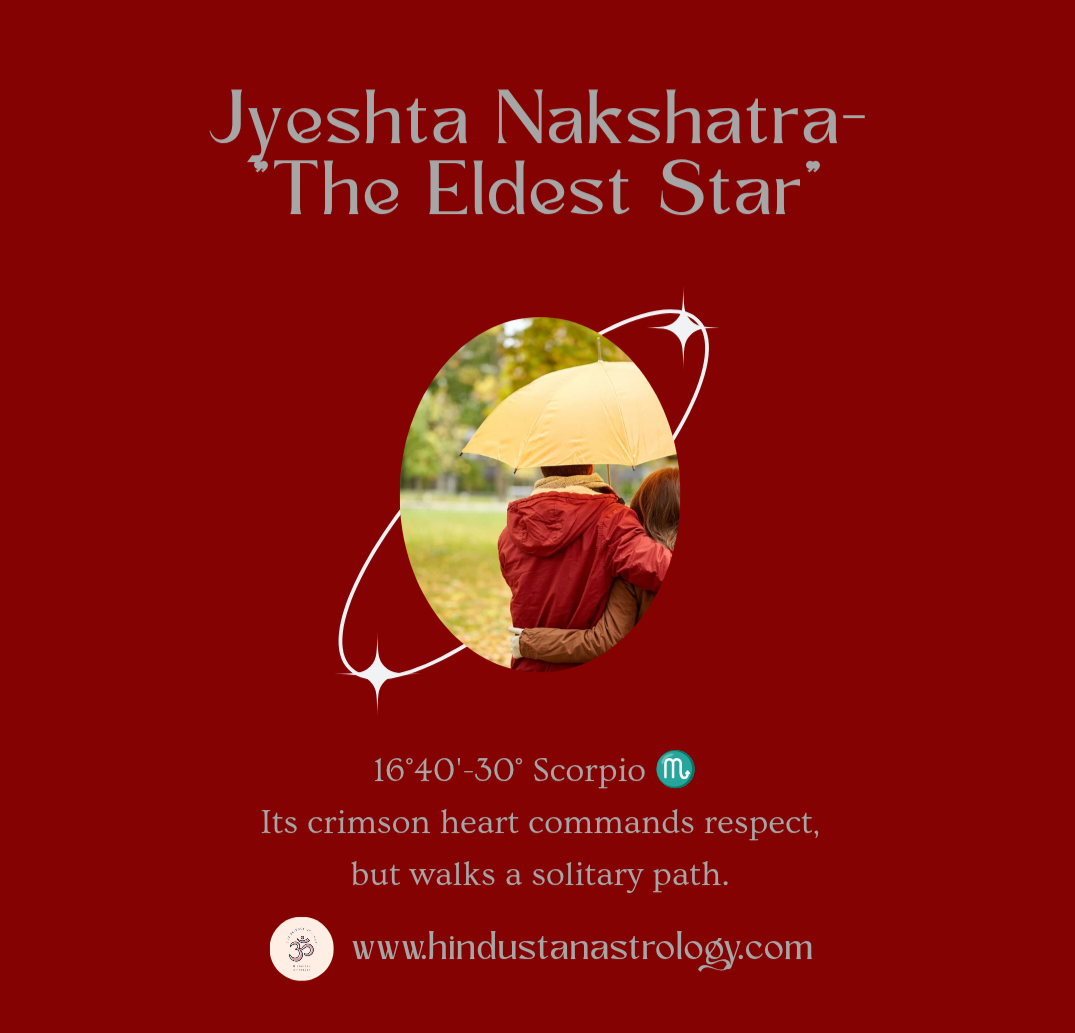
Jyeshta Nakshatra:
The Crown is Heavy, My Dear—
But You Were Born to Wear It
Book Your Reading

Uma’s Upayas on Amazon
FREE Sidereal Chart Calculator
Dear one, if you have Jyeshta prominent in your chart, you already know: you have always been the one in charge. The eldest sibling, the one who held the family together, the friend who organizes everything, the leader who cannot afford to show weakness. You carry the weight of authority like a crown that was placed on your head before you were ready. You have been betrayed—perhaps by those you trusted most. You have been isolated—perhaps by the very power you earned. You are Indra, the king of the gods, who won his throne through battle and then spent eternity afraid of losing it. Let’s talk about your power, your loneliness, and the profound wisdom that comes from ruling your own soul.
Attributes of Jyeshta Nakshatra
-
Sanskrit Name: ज्येष्ठा (Jyeshta) – “The Eldest,” “The Chief,” or “The Most Excellent”
-
Rashi (Zodiac Sign): Scorpio (Vrishchika) – 16°40′ – 30°00′ Scorpio
-
Ruling Planet: Mercury (Budha – intellect, communication, and strategy)
-
Ruling Deity: Indra, the king of the gods, symbolizing sovereignty, rulership, and the battles required to maintain one’s throne
-
Fixed Star: Antares (Alpha Scorpii), the “Heart of the Scorpion,” one of the four Royal Stars of ancient Persia
-
Symbol: A circular amulet or talisman (protection and power), an umbrella, or an earring (status and authority)
-
Animal: Male deer (solitary and vigilant)
-
Color: Deep blood red or crimson – the color of Antares, life force, passion, and protective power
-
Nature (Gana): Rakshasa (demonic – fierce, powerful, and transformative)
-
Guna (Quality): Tamasic (inertia, darkness, and the struggle against material bondage)
-
Element: Water
-
Key Themes: Authority, leadership, isolation, betrayal, protection, esoteric knowledge, and the transformation of emptiness into power
-
Special Notes: The entire sign of Scorpio is the debilitation (neecha) sign for the Moon. Jyeshta also contains the Gandanta zone at its end (26°40′ – 30°00′ Scorpio), transitioning into Mula nakshatra in Sagittarius
The Fixed Star: Antares, the Heart of the Scorpion
Jyeshta is anchored by the brilliant, reddish star Antares (Alpha Scorpii), one of the four “Royal Stars” of ancient Persia. Known as the “Rival of Mars” (Anti-Ares), Antares burns with a fiery, warlike energy. In the sky, it marks the very heart of the Scorpion. This celestial placement speaks volumes about Jyeshta’s nature. It is about the heart of the matter, the core of passion, and the courage to fight for what one believes is theirs. Just as Antares is a beacon in the night sky, Jyeshta natives often find themselves as central, commanding figures in their own dramas, compelled to defend their position, reputation, and resources with fierce determination.
The Color: The Crimson Heart
The color for Jyeshta is a deep, blood red or crimson. This powerful hue resonates on multiple levels with the nakshatra’s essence. It is the color of the star Antares, the “Rival of Mars,” which burns with a reddish glow in the night sky. It is the color of life force, passion, and the raw courage required for battle, mirroring the spirit of its ruling deity, Indra. This red also represents the protective, talismanic power of the nakshatra—like the circular amulet, it is a shield of vital energy. Furthermore, it connects to the deep, often turbulent, emotional waters of the debilitated Moon in Scorpio, reflecting the intense feelings—from rage to profound loyalty—that characterize those born under this star. It is the color of the elder who has been seasoned by life’s battles, bearing the scars and the strength that come from them.
The Myth of Indra: The King and His Shadows
Once upon a time, in the resplendent celestial city of Amaravati, ruled the great king of the gods, Indra. His throne was not inherited, but earned through fierce tapasya—austerities so profound they shook the foundations of the cosmos—and a great battle where he vanquished the dragon Vritra, who had hoarded the waters of life itself. By slaying the serpent, Indra released the nourishing rains upon the Earth, becoming the savior and the undisputed sovereign of the three worlds. He was the Jyeshta, the Eldest and the Chief, residing in a palace that moved at will, surrounded by the wish-fulfilling Kalpa-vriksha tree and attended by the celestial musicians, the Gandharvas, and the beautiful Apsaras. His elephant, Airavata, born from the churning of the cosmic ocean, stood as a mighty symbol of his royal power.
Yet, for all his glory, a shadow lingered in Indra’s heart. His throne, the prize of his own struggle, was a prize others coveted. He knew that any mortal or sage, through greater penance or a purer heart, could accumulate enough spiritual merit to challenge his reign. This knowledge festered within him, turning his sovereignty into a cage of perpetual vigilance.
His court was a place of dazzling beauty, but also of whispered intrigues and hidden fears. The Apsaras, whose dances were meant to delight, often became his weapons, sent to earth to seduce and distract ascetics from their powerful meditations. The Gandharvas spread rumors to sow discord. Indra’s own guru, Brihaspati, was once so offended by the god’s pride that he abandoned his post, leaving Indra vulnerable and weakened. This was the great paradox of his rule: the very power he wielded to protect his throne was the same power that isolated him, breeding a deep-seated paranoia that no amount of Soma, the nectar of immortality, could quench.
The core of Indra’s story is the burden of the crown. He was tasked with maintaining cosmic order, yet he was constantly looking over his shoulder, fearing the next usurper. His greatest battles were often not against external demons, but against the internal demons of insecurity, jealousy, and the terror of being rendered obsolete. He was a mighty king who often acted like a frightened custodian, desperately trying to protect a kingdom he feared was never truly his.
And so, the soul of the Jyeshta native is imprinted with this divine drama. They are the ones put in charge, the natural leaders and protectors. But they also inherit Indra’s dilemma: the loneliness of command, the constant threat of betrayal from those who envy their position, and the profound, internal struggle to wield authority with wisdom instead of fear, to be a true king and not merely a jealous guardian of a temporary throne.
Jyeshta in Real Life: The Weight of the Crown
In the birth chart, a prominent Jyeshta (especially the Moon) creates individuals who are naturally thrust into leadership roles. They are the eldest sibling who must care for the family, the policeman or military leader entrusted with authority, or the one in a friend group who ends up organizing everything. The Antares influence often manifests in careers involving conflict, protection, or high-stakes environments.
This authority, however, comes at a cost. As “the Eldest,” they often attract intense jealousy and become targets for betrayal and rejection. Their path is one of learning to handle the loneliness of command. With Mercury as the ruler, the mind is sharp and strategic, but if the chart is otherwise weak, this can devolve into cunning, manipulation, and even a fascination with the darker arts as a means of control or revenge.
The debilitation of the Moon in Scorpio brings profound emotional depth and challenges related to fertility and nurturing. It is not uncommon for Jyeshta natives, particularly women, to have difficulties bearing their own children, yet they can become the primary caretakers for others’ children, such as a sibling’s. This reflects the “Alaxmi point” – a theme of emptiness and barrenness that stands in stark contrast to Rohini’s fertility. Yet, nature abhors a vacuum. This very emptiness can create a powerful suction for material wealth. The deep, gandanta-like emotions, when channeled, can produce magnificent actors and artists who can tap into the darkest and most powerful parts of the human experience.
The Gandanta Zone: The Spiritual Knot at Jyeshta’s End
In Vedic astrology, Gandanta refers to the “knot at the end” of a cycle, a critical and spiritually sensitive transition point. These points occur at the junctions between water and fire signs (26°40′ water – 3°20′ fire), specifically at the end of Pisces-Aries (Revati-Ashwini), Cancer-Leo (Ashlesha-Magha), and Scorpio-Sagittarius (Jyeshta-Mula). The final 3°20′ (one pada) of these water signs and the first 3°20′ of the following fire signs are considered the Gandanta zone. It is a place of dissolution and rebirth, where karmic threads from the past are knotted and must be untangled.
This applies profoundly to Jyeshta, as its final pada (26°40′ to 30°00′ Scorpio) is a Gandanta point, transitioning into the fiery Mula nakshatra in Sagittarius. A planet, especially the Moon, placed here indicates a soul grappling with intense, unresolved karmic impressions from the past. Life events connected to this placement are often sudden, transformative, and feel fated. For a Jyeshta native with a Gandanta Moon, the deep emotional currents of Scorpio culminate in a crisis that forces a leap into the philosophical and purifying fires of Mula. This can manifest as pivotal endings that are actually spiritual beginnings, forcing the native to release deep-seated attachments and emotional patterns to evolve.
When planets in a chart or in transit are Gandanta, it can feel like we are drowning. However, do not get wrapped up in the fear—Gandanta Zones are meant to teach us to swim.
Client Chronicles: The Moon in Jyeshta
Client 1: The Outcast Healer – This client’s Moon in Jyeshta, conjunct Rahu and Pluto in the 6th house, painted a picture of a deeply karmic and challenging relationship with his mother. She battled drug addiction, went to jail, and after finally achieving sobriety, tragically passed away due to health complications from her past struggles. This 6th house placement shows a past-life debt being worked out through the shadow of the mother. He became the outcast in his family, facing the classic Jyeshta themes of rejection and betrayal. The ruler of his Moon, Mars, however, is powerfully placed in the 5th house of talent with a stellar conjunction, and he has channeled his profound emotional turmoil into creating powerful music as his therapy and salvation.
Client 2: From Partier to Patriarch – This client has a 1st house Moon in Jyeshta conjunct Venus and Neptune, making him naturally charismatic and popular, with a circle of unusual friends (strong 11th house). In his youth, the Jyeshta shadow manifested as a descent into partying and drug experimentation, even getting deported from Australia (a 12th house Sun theme). He did not face major betrayal until his first marriage, a classic Jyeshta initiation that forced him to reclaim his self-worth. His destiny, shown by a 5th house Rahu-Saturn in Pisces, was fulfilled when he transformed his “party” nature into a successful brewery business, creating the very atmosphere he was known for. Becoming a father later in life completed his journey from a directionless “eldest of the party” to a responsible and successful patriarch.
Planetary & Lagna Conjunctions – What Jyeshta Brings to Your Chart
Remember: these are themes, not predictions. If Jyeshta is strong here, see what resonates—and know that the crown is heavy, but you were born to wear it. For my friends coming from Western astrology: yes, Uranus, Neptune, and Pluto matter in Jyotish, especially when they touch your Moon or Lagna. Here’s how they show up in Jyeshta.
| Placement | What It Often Brings |
|---|---|
| Lagna (Ascendant) | You came into this world as an elder. People meet you and sense your authority, your wisdom, your quiet command. You do not need to raise your voice to be heard. You have a presence that says “I have been through things, and I am still standing.” Your body may be strong, your eyes piercing, your stillness powerful. You may have been told you are intimidating or hard to read. The truth is, you have simply learned that power is safer when it is quiet. In past lives, you were the chief, the monarch, the one who held the tribe together. You still are. Your lesson is to learn that true authority does not need to defend itself. The king who is secure in his throne does not look over his shoulder. |
| Moon | Your emotional world is a deep, dark ocean—powerful, mysterious, and capable of both great calm and great storm. You feel everything, but you show little. You have known betrayal, and that betrayal has made you cautious. Your mother was likely a complex figure—either a source of profound wounding or a woman of immense strength who taught you to survive. You may have had to mother yourself, or you may have been the one who protected your mother. The gift is that you have extraordinary emotional depth and resilience. The shadow is that you may become paranoid, expecting betrayal even where it does not exist, or you may isolate yourself to avoid being hurt. Your healing comes when you learn that vulnerability is not weakness. You can let people in. Not everyone is a usurper. |
| Sun | Your identity is tied to authority, leadership, and the protection of your domain. You are here to be in charge—not because you want power, but because you are good at it. Your father may have been a powerful figure, or he may have been absent, leaving you to become your own authority. You shine brightest when you are leading, protecting, and making decisions that affect others. The shadow is that you can become authoritarian, controlling, or paranoid about losing your position. Your life’s work is to learn that the best leaders are not the ones who hold the tightest grip. They are the ones who empower others to lead alongside them. |
| Mars | Your drive is fierce, protective, and strategic. You do not start fights, but you finish them. You are a natural defender of the weak, the vulnerable, and the things you love. The shadow is that you can become vengeful, holding grudges for years, or you can become so focused on protecting your position that you see enemies everywhere. Your mother may have been a fighter, or she may have taught you that the world is dangerous. Your healing comes when you learn that the greatest battle is the one you do not have to fight. You can put down your sword and still be safe. |
| Mercury | Mercury rules Jyeshta, so this placement is powerful. Your mind is strategic, sharp, and deeply perceptive. You see the hidden motives behind people’s actions, and you are rarely fooled. You are a natural strategist, detective, or leader because you can anticipate threats before they arrive. The shadow is that you can become manipulative, using your intelligence to control others, or you can become paranoid, seeing conspiracies where there are none. Your mother may have been intellectual, critical, or verbally sharp. Your healing comes when you learn that the truth does not always need to be a weapon. You can see clearly and still choose kindness. |
| Venus | Your relationships are intense, protective, and often marked by power struggles. You love deeply, but you also watch for betrayal. You may attract partners who challenge your authority, or you may find yourself in relationships where you are the one in charge. The shadow is that you can become possessive, jealous, or controlling, or you can use your beauty and charm as tools of manipulation. Your mother may have been beautiful, powerful, or focused on appearances. Your lesson is to learn that love is not a throne to be defended. It is a garden to be tended. You cannot control love. You can only receive it. |
| Jupiter | Your authority is expansive and blessed. You may be a leader in spiritual, educational, or philanthropic fields. You are generous with your power, and you attract loyal followers. The shadow is that you can become dogmatic, insisting that your way is the only way, or you can become too trusting, believing that your authority protects you from betrayal. Your mother may have been generous but overwhelming. Your lesson is to learn that wisdom is the highest form of authority. You do not need to control others. You just need to speak your truth and let it land where it may. |
| Saturn | Your authority is hard-won, disciplined, and burdened by responsibility. You did not ask to be in charge, but you were, and you have carried that weight with dignity. The shadow is that you can become rigid, joyless, or isolated, believing that your position requires you to be alone. Your mother may have been strict, absent, or burdened. Your gift is that what you build lasts. You are not a flashy leader. You are a foundation layer. Your lesson is to learn that you are allowed to rest. You are allowed to be vulnerable. The crown does not have to be worn every moment. |
| Ketu | You have been a powerful leader in past lives, and in this life, you may reject that path. You may feel disconnected from your authority, or you may struggle to claim your rightful place. The shadow is that you can become detached, refusing to lead even when you are needed, or you can become so focused on spiritual authority that you neglect earthly responsibilities. Your mother may have been spiritually gifted but emotionally absent. Your gift is that you have past-life wisdom about the nature of power and betrayal. Your lesson is to come back into your authority. You do not have to be a tyrant. But you do have to lead. It is your dharma. |
| Rahu | Your hunger for authority is obsessive, unconventional, and never satisfied. You may chase power in strange places, or you may be drawn to taboo forms of leadership—underground movements, secret societies, or revolutionary politics. Your mother may have been unconventional, unpredictable, or a rebel. The shadow is that you can become addicted to the thrill of power, confusing control with safety, or you can become a master of manipulation, using any means to secure your throne. Your gift is that you can break cycles of corruption and create entirely new forms of leadership. Your lesson is to learn that true authority does not need to be chased. It arrives when you are ready. And you are ready now. |
| Uranus (outer planet) | Your authority is electric and revolutionary. You cannot follow traditional paths to leadership. You must invent your own. Your mother may have been unconventional, erratic, or absent. In Jyeshta, Uranus gives you the gift of radical leadership: you can see where old systems of power have failed and create something entirely new. The shadow is that you can be inconsistent, abandoning your followers when leadership becomes boring. Your lesson is to learn that true leadership is not about excitement. It is about showing up, again and again, even when it is not glamorous. You can be revolutionary and reliable. You can change the world and keep your promises. |
| Neptune (outer planet) | Your authority is mystical and dreamy. You may not know if you are leading or being led. Your mother may have been illusive, addicted, mentally unwell, or spiritually gifted in ways that left you unsure of your own boundaries. In Jyeshta, Neptune blurs the line between power and illusion—you may not know if your authority is real or imagined. The gift is that you have extraordinary compassion and can lead through inspiration rather than force. The shadow is that you can become lost in fantasy, using leadership to escape rather than to serve. Your lesson is to anchor yourself in reality. You cannot lead from the clouds. Come down. Touch the earth. Then lead. |
| Pluto (outer planet) | Your authority is underworld authority—volcanic, transformative, and absolutely relentless. You are not here for small leadership. You are here to transform the very nature of power itself. Your mother likely had a dark past (secrets, abuse, power struggles), and your relationship with authority may feel like a karmic battleground. In Jyeshta, Pluto gives you the power to transform corruption into justice. The shadow is that you can become tyrannical, using your power to control rather than to liberate, or you can become addicted to intensity, confusing domination with leadership. Your lesson is brutal and beautiful: You are not here to be the king who rules from a throne of fear. You are here to be the elder who guides from a place of wisdom. And you cannot do that if you are still afraid of losing what you have. |
Famous People and the Jyeshta Signature
Jennifer Aniston, actress – With her Moon conjunct Mars and Neptune in the 2nd house, Aniston embodies Jyeshta’s public face of strength and nurturing. She became America’s sweetheart, the “eldest sister” to an entire generation of friends on the globally popular show Friends. Her highly publicized personal life, marked by betrayal and public scrutiny, reflects Jyeshta’s themes of isolation and navigating challenges in the public eye, while her 2nd house placement has secured her immense financial wealth and status.
John Belushi, comedian – Belushi’s 12th house Moon in Jyeshta speaks to a life of hidden struggles and self-undoing. He was a comedic chief, a larger-than-life force on Saturday Night Live who led a wild party lifestyle. The 12th house connection, combined with Jyeshta’s intensity, points to the secret battles with addiction that ultimately led to his tragic, early demise, a classic manifestation of the nakshatra’s shadowy depths.
Brandis Bradley, lawyer and fashion entrepreneur – Brandis’s life is defined by intense Kala Sarpa Yoga, creating extreme swings from constraint to breakthrough. This is driven by her Moon in Jyeshta, a nakshatra requiring one to overcome crises to claim authority. Her Moon conjunct Uranus and Neptune in the 9th house channels this into unconventional, creative leadership as a lawyer and businesswoman. She carved her path as a legal elder who now reigns in fashion, using her strategic mind to build an empire. Her success embodies the Jyeshta phoenix—rising from struggle to sovereign power, guiding others through her hard-won wisdom.
Naomi Campbell, supermodel – With her Moon conjunct Neptune and the Midheaven (MC) in the 11th house, Campbell is a quintessential Jyeshta elder in the world of fashion. She commands authority and is known for her fierce, almost warrior-like presence on the catwalk. Her life, filled with both immense fame and public scandal, reflects the Jyeshta dynamic of being at the top, attracting both admiration and intense criticism from her networks (11th house).
Vin Diesel, actor – Diesel’s 2nd house Moon in Jyeshta fuels his iconic roles as a protective, tribal leader in the Fast & Furious franchise. The 2nd house gives him a distinctive, gravelly voice and a powerful physical presence. His entire cinematic persona is built around the theme of “family,” but he is always the undisputed, eldest figure in charge, defending his own against external threats.
Albert Einstein, physicist – His Jyeshta Moon in the 6th house of research, opposing Pluto in the 12th, allowed him to challenge the established scientific “authority” and peer into the deepest, most hidden (Pluto) secrets of the universe (12th house). He became the chief revolutionary of physics, his ideas initially facing rejection before being universally accepted, a classic Jyeshta journey of the elder visionary.
Roy “Halston” Frowick, fashion designer – Halston’s Moon in the 2nd house, opposing Venus, placed him as a reigning authority in American fashion in the 1970s. He defined an era with his minimalist, luxurious designs, creating a “uniform” for the elite. The opposition to Venus in Taurus (its sign ruler) highlights the tension between Jyeshta’s austerity and Taurus’s sensual beauty, a dynamic that played out in his dramatic rise and fall.
Richard Gere, actor – Gere’s 12th house Moon in Jyeshta aligns with his frequent roles as solitary, spiritually-seeking, or internally conflicted characters. His well-known dedication to Tibetan Buddhism is a 12th-house pursuit of liberation, offering a spiritual remedy to the deep emotional intensity and potential for isolation that comes with this placement.
Lillian Gish, actress – As a pioneering star of the silent film era, Gish was literally one of the “eldest” and most respected figures in cinema. Her Moon conjunct Venus in the 3rd house allowed her to communicate (3rd house) with profound emotional depth and artistry (Venus), often playing characters of immense resilience and innocence facing harsh circumstances, perfectly capturing Jyeshta’s theme of dignified endurance.
Vincent Van Gogh, artist – His 6th house Moon in Jyeshta reflects a life of daily struggle, mental health challenges, and feeling like an outcast. Yet, from this barren emotional landscape (the Alaxmi point), he produced some of the most fertile, vibrant, and emotionally charged art in history. He was an elder in his artistic vision, utterly unappreciated in his time, facing the ultimate betrayal of anonymity.
Jeff Goldblum, actor – Goldblum’s Moon conjunct Venus in the 5th house gives his Jyeshta energy a quirky, creative, and charming outlet. He often plays the intelligent, somewhat isolated expert who steps into a leadership role in chaotic situations. His unique charisma and artistic talent (5th house) allow him to channel Jyeshta’s depth in a way that is both authoritative and endearing.
Michael Jordan, athlete – Michael Jordan’s competitive fury is explained by a powerful Parivartana Yoga (planetary exchange) between his Jyeshta Moon in the 6th house (service, competition) and his Mars Rx in the 2nd house (speech, wealth). This exchange directly links his emotional need to dominate (Moon in Scorpio, ruled by Mars) with a sharp, cutting tongue (Mars in Cancer, ruled by the Moon). He was the undisputed chief on the court, known for his harsh, demanding words toward teammates, using criticism as a tool to enforce his supreme authority. This relentless drive, fueled by this internal planetary loop, ensured he overcame all betrayal and rejection to secure his legendary status and immense wealth.
Nicole Kidman, actress – Kidman often portrays strong, complex, and sometimes emotionally isolated women, a direct reflection of her 2nd house Jyeshta Moon. She commands the screen with a powerful presence and a voice that can convey deep reservoirs of feeling, using her wealth of talent with speech (2nd house) to explore the shadows of the human experience.
Stephen King, author – His Moon conjunct an exalted Jupiter and Ketu in the 5th house with a Kala Sarpa Yoga is a perfect recipe for a master storyteller. Jyeshta’s depth provides access to our deepest fears and shadows, which the 5th house of creativity channels into iconic horror and fantasy. The combination makes him the undisputed “eldest” and authority in his genre, a prolific chief of literary fear.
Lenny Kravitz, musician – With his Moon in the 12th house opposing his Sun, Kravitz embodies the Jyeshta theme of spiritual isolation and otherworldliness. His music and persona are a blend of raw, rock authority and a transcendent, almost psychedelic spirituality. This placement speaks to finding one’s power (Sun) through solitude, retreat, and confronting the subconscious (12th house).
Bam Margera, skateboarder – Margera’s Moon conjunct Neptune in the 6th house reveals a life where daily routines and health (6th house) are blurred by addiction and escapism (Neptune). His role as the wild, chaotic leader of the Jackass crew placed him in a position of authority that ultimately became self-destructive, showcasing Jyeshta’s potential for a painful downfall when its energies are not mastered. He is clean and sober now and has abandoned his former lifestyle to embrace the ultimate Scorpio transformation.
John Mayer, musician – Mayer’s 1st house Moon conjunct Neptune makes his Jyeshta emotional depth a core part of his identity and artistic brand. He is a guitar virtuoso, an “elder” in modern blues-pop, whose career has been marked by intense public relationships and a journey of self-discovery, often navigating the betrayal and scrutiny that comes with his prominent status.
Al Pacino, actor – Pacino’s 5th house Moon in Jyeshta, opposing Mars and Venus in Taurus, fuels his iconic intensity and his legendary roles as authoritative, isolated, and often morally complex figures. The 5th house gives him a dramatic, creative flair, allowing him to channel deep, primal emotions into his performances, making him one of the most respected “elders” of acting.
Joan Rivers, comedienne – Rivers was a comedic chief, the eldest who fearlessly ruled the red carpet and broke barriers for women in comedy. Her 9th house Moon opposing the Sun in Taurus gave her a worldview (9th house) built on piercing critique and a relentless work ethic. She faced immense betrayal and rejection early in her career, only to build an empire through her sharp, Mercurial wit.
Donald Trump, former US President – With his Moon conjunct an exalted Ketu in the 4th house, opposing a stellium in the 10th, we see the ultimate manifestation of the “Alaxmi to Laxmi” paradox. His life is a testament to filling a vacuum with immense material wealth and ultimate authority, while his presidency was defined by constant battles, perceived betrayals, and a fierce defense of his “throne” and homeland (4th house).
Mike Tyson, boxer – His Jyeshta Moon-Ketu conjunction in the 4th house mirrors Trump’s in its intensity. The 4th represents home and emotional security, which for Tyson was fraught with poverty and instability. Jyeshta’s warlike Antares energy was channeled into his ferocious boxing style, a literal battle for supremacy and wealth, overcoming a barren beginning to become the youngest heavyweight champion ever.
Tiger Woods, golf professional – Woods’ Moon conjunct Venus and Neptune in the 3rd house made him a prodigious talent (3rd house of early skill) who became the undisputed chief of his sport. His story is a classic Jyeshta saga: rising to absolute authority, facing a very public and humiliating betrayal of his own making (the shadow of Mercury), and then orchestrating a dramatic comeback to reclaim his elder status.
Remedies and Upayas for Jyeshta Nakshatra
To balance the intense energy of Jyeshta, certain spiritual practices can be immensely helpful:
-
Worship of Indra and Ganesha: Chanting mantras dedicated to Lord Indra can help harness the energy of righteous leadership. Worshipping Ganesha, the remover of obstacles, helps clear the path of the paranoia and blockages Jyeshta can attract.
-
Mercury-Related Practices: Since Mercury rules Jyeshta, strengthening Mercury is key. This can include wearing green clothes, donating green lentils on Wednesdays, or chanting the Budha (Mercury) mantra.
-
Charity: Given its “Alaxmi” association, acts of charity are powerful remedies. Donating to the elderly, to those in authority (like police or military charities), or providing umbrellas and protective talismans to those in need can pacify the nakshatra.
-
Mantra Therapy: Regularly chanting the root mantra for Jyeshta, “Om Om Om,” is considered highly beneficial. Reciting the Maha Mrityunjaya Mantra can also help heal the deep emotional wounds associated with the debilitated Moon.
-
Practice Vulnerability: The most powerful remedy for Jyeshta is learning to let your guard down. Not everyone is trying to take your throne. Let someone in. Trust someone. It is the only way to heal the loneliness of the crown.
Conclusion: The Wisdom of the Crone
Jyeshta is not an easy path. It is the journey of the crone, the elder who has seen everything—the battles, the betrayals, the barren winters. It teaches that true authority is not about dominating others, but about mastering the self. The emptiness of the Alaxmi point is not a permanent curse, but a sacred void, a womb of darkness from which profound creativity and unexpected abundance can be born.
If this is your nakshatra, remember:
-
You are the eldest. You carry the weight. That weight is not a punishment. It is an honor.
-
You have been betrayed. That betrayal was not the end of your story. It was the beginning of your wisdom.
-
You are allowed to rest. The crown does not have to be worn every moment. Put it down. Breathe. You have earned it.
When the Jyeshta native learns to wear their authority with humility and channel their deep emotional waters into compassionate leadership or artistic genius, they truly become the “Most Excellent” star, a beacon of hard-won wisdom in a challenging world.
With love from your Vedic astrologer 👑
Book Your Reading
#astrology #vedicastrology #Jyotish #Jyeshta #nakshatra #Scorpio


