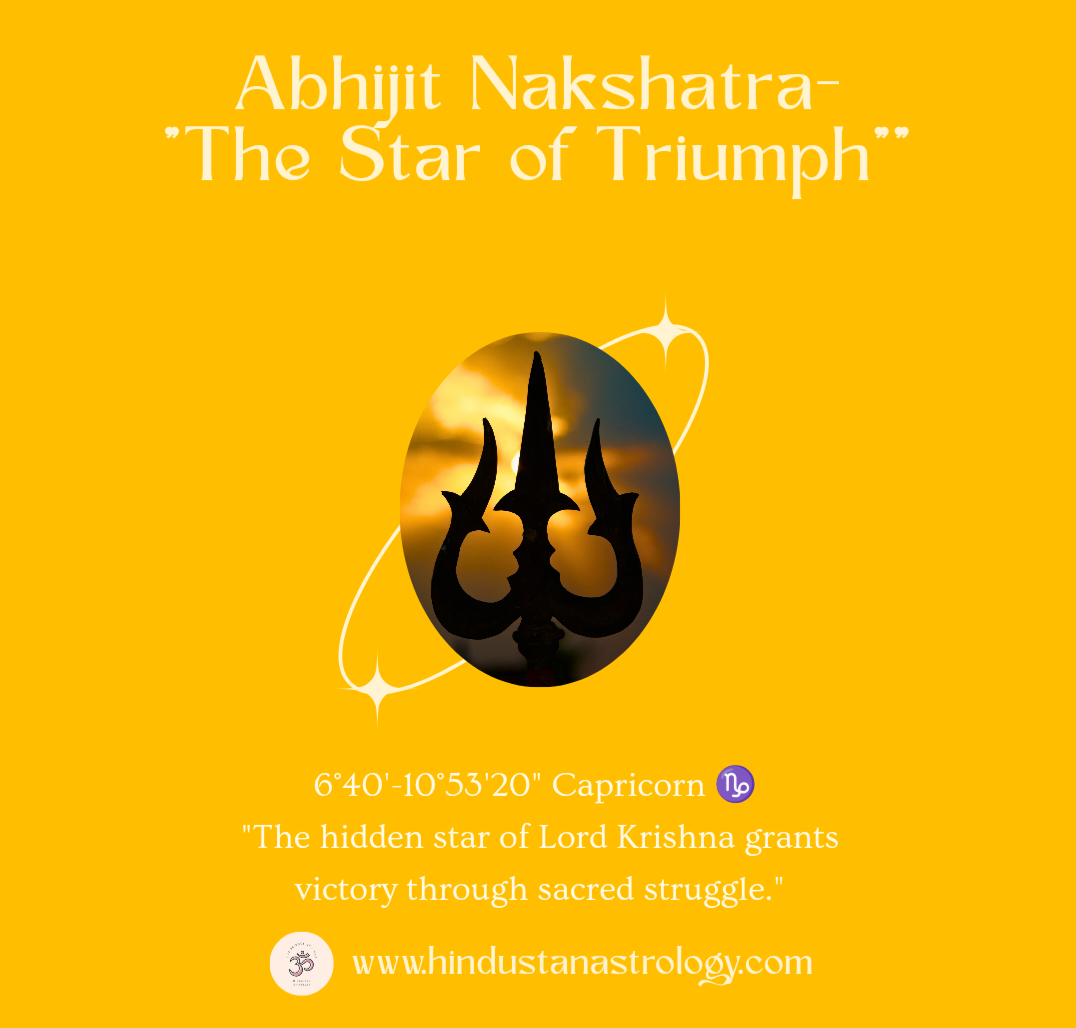
Abhijit Nakshatra: The Hidden 28th Star that Lord Krishna Called His Own

Uma’s Upayas Astrological Aromatherapy on Amazon
FREE Sidereal
A Note on This Article: This is a generalized Vedic astrology blog post based on this nakshatra. For a truly personal reading, please consult your individual birth chart. 🙏
Have you ever felt that there’s something more to the cosmos than what meets the eye? A hidden current of power that flows beneath the surface of everyday life? In the sacred tradition of Jyotish, such a mystery exists in the form of Abhijit Nakshatra—the forgotten 28th star that Lord Krishna himself claimed as his own.
Today, we’re going to pull back the celestial veil and explore this mystical asterism. We’ll discover why it’s not commonly used, what makes it so special, and most importantly—what it means if this victorious energy touches your life.
The Tale of the Hidden Prince
Once upon a time, in the vast and ordered cosmos of Jyotish, there existed a powerful and revered king among the stars. He was known as Abhijit, “The Victorious One,” and his light was the 28th Nakshatra—a celestial point of immense power and auspiciousness.
In the ancient wisdom, the sky was not just a dome of twinkling lights but a living clock, and Abhijit was a moment of ultimate triumph.
You see, the Moon God, Chandra, had 27 wives—the beloved Nakshatra goddesses. But Abhijit was different. Abhijit was their brother—a masculine energy, a prince among stars, and the most special of them all. So special, in fact, that he was said to reside in the magnificent peacock feather of Lord Krishna himself, a secret weapon of divine timing.
This is the tale of that forgotten prince, Abhijit Nakshatra.
The Celestial Coordinates of Victory
Let’s now chart the prince’s place in the heavens. Abhijit is not a standalone territory but a sacred confluence—a meeting point of two mighty asterisms.
| Attribute | Detail |
|---|---|
| Sanskrit Name | अभिजित् (Abhijit) |
| Meaning | “The Victorious One” |
| Degrees | 6° 40′ to 10° 53′ 20″ in Capricorn |
| Rashi (Sign) | Capricorn (Makara Rashi), ruled by Saturn |
| Location | Begins in the last quarter of Uttarashada, extends into the first part of Shravana |
| Ruling Planet | Mercury (Budha) — bestowing intellect and communication |
| Secondary Influence | Saturn (Shani) — as lord of Capricorn |
| Ruling Deity | Lord Brahma — the Creator himself |
| Fixed Star | Vega (Lyra) — one of the brightest stars in the northern sky |
| Symbols | Trifola (trident), Svastika, Horse’s head |
| Animal Symbol | Male horse (Ashwamukha) — representing speed, power, and victorious charge |
| Guna (Quality) | Tamasic — but with a unique transformative quality; the darkness before dawn that births victory |
| Primary Color | Golden Yellow — victory’s radiant glow |
| Secondary Colors | White (Brahma’s purity), Brown (earthy stability) |
| Element | Fire — the transformative flame of victory |
| Direction | North — toward the pole star, the fixed point of destiny |
| Sound | The sacred syllable connected to creation and victory |
Understanding Abhijit’s Guna
Abhijit is primarily Tamasic in nature—the quality of inertia, darkness, and material density. This may seem contradictory for a star of victory, but consider:
🌑 Tamas provides the stability and patience needed to endure long struggles
🌑 It represents the darkness before dawn—the final, most intense moment before victory
🌑 Abhijit’s tamasic quality gives natives the stubborn endurance to outlast enemies
🌑 Through this darkness, the light of victory shines even brighter
The Horse Symbolism
The male horse (Ashwamukha) as Abhijit’s animal symbol is deeply significant:
🐎 Speed — victory comes swiftly to those who wait
🐎 Power — unstoppable force when charging toward goals
🐎 Loyalty — horses fight for their herd; Abhijit natives fight for their community
🐎 Warrior spirit — the horse carries the warrior into battle
Like the horse, Abhijit energy is not meant to be caged. It runs free toward victory, carrying its community on its back.
This placement makes Abhijit the golden hour that belongs to both Uttarashada and Shravana—and to neither. It is a unique fusion of their essences.
The Color of Victory: Golden Yellow
Every nakshatra carries its own vibrational frequency, and color serves as a powerful conduit for connecting with that energy. For Abhijit, the victorious star, the primary auspicious color is golden yellow .
This radiant hue represents:
-
Victory and accomplishment — the shimmer of success after struggle
-
Divine grace — the peacock feather of Krishna, hidden yet glorious
-
Intellect and wisdom — Mercury’s influence on this nakshatra
-
Spiritual illumination — the “eye of the zodiac” awakening
Some traditions also associate Abhijit with white , the color of Lord Brahma, the nakshatra’s ruling deity. White represents the pure, creative potential of new beginnings—the blank canvas upon which victory is written.
Additionally, brown and yellow appear in certain sources as Abhijit’s lucky colors , grounding the victorious energy in earthy stability while maintaining that essential golden glow.
How to Work with Abhijit’s Colors
✨ Wear golden yellow during important new beginnings, especially during Abhijit Muhurta (the daily victorious window around noon)
✨ Offer yellow flowers or ghee lamps to Lord Krishna or Lord Brahma
✨ Surround yourself with golden hues in your environment when undertaking endeavors requiring courage and triumph
✨ Meditate on a golden light at the crown of your head during Abhijit Muhurta, visualizing the victorious star Vega shining upon you
✨ For daily connection, consider incorporating a small golden token or yellow gemstone into your meditation practice
The color golden yellow reminds us that Abhijit natives carry within them a radiance earned through struggle—a light that cannot be dimmed by enemies or obstacles. It is the color of the hidden prince finally stepping into his victory.
The Myth: Lord Krishna and the Hidden Nakshatra
And now, the most cherished story of all—the one that reveals the true heart of Abhijit.
As the great war of Mahabharata loomed, the Kauravas, in their arrogance, sought to claim the most powerful moment for themselves. They decided to begin the battle during the Abhijit nakshatra, for it is said that anything begun in this victorious moment is destined to succeed.
But Lord Krishna, the divine strategist, knew this secret. To protect the Pandavas and ensure the triumph of Dharma (righteousness), he performed a celestial act of magic.
He reached up and plucked the Abhijit nakshatra from the sky, concealing it within the beautiful peacock feather he always wore in his hair. Without this auspicious moment, the Kauravas’ plans were foiled.
This is why, in the celestial timeline, Abhijit is sometimes considered “hidden.”
And this is why Lord Krishna, in the Bhagavad Gita, declares with divine authority:
“Among the Nakshatras, I am Abhijit.”
He is the victorious one. He is the hidden blessing. He is the ultimate time, which, when found and utilized, leads to certain victory.
This myth cements Abhijit as the personal nakshatra of Lord Krishna—the embodiment of divine grace and triumph.
What It Means to Be Born Under Abhijit
When a soul takes birth under the victorious star, their life story becomes one of struggle, transformation, and ultimate, undeniable success.
The Character of the Victorious One
Abhijit natives carry a king’s destiny. They are:
-
Highly learned and respected by society
-
Naturally courteous and soft-spoken
-
Optimistic with a character that shines bright
-
Possessors of a sharp, penetrating intellect
-
Often drawn to the deepest mysteries of life—occult, spirituality, philosophy
Their personality balances head and heart beautifully, using both reason and emotion to navigate the world.
Career and Fortune
In their professional lives, Abhijit natives are natural-born go-getters. They:
-
Aspire to top-level positions and have the determination to achieve them
-
Excel in fields requiring intelligence, responsibility, and authority
-
Make excellent CEOs, bankers, administrators, scientists, and researchers
-
Often shine as spiritual leaders or social workers
-
Find great success in travel-related businesses or foreign lands
Fame, wealth, and respect are not just wishes for them—they are their destiny, often manifesting powerfully after age 28 or 30.
Love, Family, and Relationships
The path of love for an Abhijit native is often a complex journey:
-
Some may marry early (around age 23), which can bring challenges
-
Multiple marriages are possible for some natives
-
Women of this nakshatra may initially resist marriage due to difficult early impressions, but often find happy partnerships after 27 or 28
-
The spouse is typically loving and supportive, becoming a source of stability
-
They love children deeply and often have large families
-
The eldest child frequently plays a significant role in their later life
The Journey’s Arc: From Struggle to Light
This is perhaps the most important thing to understand about Abhijit: it is not a story of instant, easy victory. It is a story of earned triumph.
-
Early life (until 23-28): Often filled with struggles, financial problems, health challenges. Childhood may be marked by delicate health.
-
The turning point: These struggles become the forge where character is tempered. They learn quickly from mistakes and develop unshakeable self-confidence.
-
Mid-life (after 28): Life takes a sharp turn for the better. Wealth, status, and recognition flow to them.
-
Later years (after 50): Having enjoyed material pleasures, they often turn deeply spiritual, seeking eternal truth—just as the victorious warrior finally seeks peace.
The Modern Abhijit Prince: IU Football Head Coach, Curt Cignetti – A Case Study in Victory
*Read more about his chart in my Full Article
Remedies to Honor the Hidden Prince
Even if you’re not born under this star, you can strengthen its victorious energy in your life through simple practices.
The Golden Window: Abhijit Muhurta
The most powerful way to connect with Abhijit is to utilize its daily 48-minute window:
Abhijit Muhurta occurs approximately 24 minutes before and 24 minutes after local noon (typically from 11:36 AM to 12:24 PM).
During this “golden period”:
-
Light a ghee lamp and sit in peaceful prayer
-
Begin new ventures, sign important documents, or start journeys
-
Chant “Abhijit Nakshatram” with faith
-
Offer prayers to Lord Krishna, Lord Brahma, or your family deity
-
Recite the Abhijit mantra to invoke blessings for victory, success, and obstacle removal
Simple Daily Practices
-
Meditate during noon hours when Abhijit energy is strongest
-
Offer water to the Sun at noon with the intention of connecting to this victorious energy
-
Study the Bhagavad Gita, particularly verses where Krishna reveals his divine forms
-
Wear or meditate on the color gold, representing the victorious essence of Abhijit
Conclusion: Finding Your Victory
The story of Abhijit Nakshatra reminds us that sometimes the most powerful forces are the ones that work behind the veil—hidden in plain sight, waiting for the right moment to reveal themselves.
It is not part of the daily 27, yet its presence is felt in the most critical moments of victory. It teaches us that true success is not just about winning, but about the journey through struggle that earns us the right to stand in the light.
Abhijit is the nakshatra of the Creator Brahma, the embodiment of the Victorious Lord Krishna, and the destiny of those rare souls born to overcome, to lead, and to ultimately transcend.
In the grand story of your life, may you always find your own Abhijit moment—the time when the divine hides in your favor, and victory is yours.
Want to know if Abhijit nakshatra plays a significant role in your birth chart? Book a personalized consultation with me, and together we’ll explore the victorious energies written in your stars.